This is the first in a series of posts I’m planning to be doing on plyometrics.
In this series, I’ll cover both lower and upper body plyometrics.
We’ll go over specific lower-body exercises that will help you jump higher, run faster, be more explosive, and even tone your fat legs.
Let’s talk about the importance of plyometrics for vertical jumps.
What Is Plyometrics?
Plyometrics can be defined simply as exercises and workouts that involve fast, explosive, and strong movements.
Plyometrics are commonly employed by athletes to improve their athletic performance, but they are also becoming increasingly popular among people looking to stay in shape and tone up.
Many people believe that plyometrics is just jump training, but that’s not true.
Although plyometrics (from now on referred to as ‘plyos’ for simplicity) are commonly used in vertical leap training, this is not their only application.

Plyos can help you jump higher, run faster, throw farther and harder, and strike harder.
With so much variation available, it’s critical to create a training regimen that caters to your specific needs. The reason for this is that your needs for throwing farther or hitting harder may differ from those of someone who’s looking to jump higher or run faster.
As a result, your plyometric workout routine will vary based on your ultimate goal, which in our case is – increasing the output of our vertical jump.
How to Use Plyometrics to Jump Higher
Okay, so we know what plyometrics are and how beneficial they can be in a variety of sports, but what about the vertical leap field? If we want to focus on jumping higher, shouldn’t we just do lower body plyometrics?
-No.
Why not?
So, if you think about jumping for a second, consider this:
Do you use your arms when jumping?
Do you have armblock?
Do you throw your elbows back while sprinting?
If the answer is yes (which it should be), you can see that you’re not only working your lower body, but also your upper body by engaging your arms and core.
When people ask me if they should focus their plyometric workout on a specific area, I always tell them that it depends on which muscle group they use the most.
For example, sprinters and jumpers, who primarily use their lower body (even though they use their arms), will stick to doing lower body plyometrics.
However, this doesn’t mean you should confine yourself to only lower-body plyometric exercises. As previously noted, the jumping mechanism involves both the upper body and the arms.
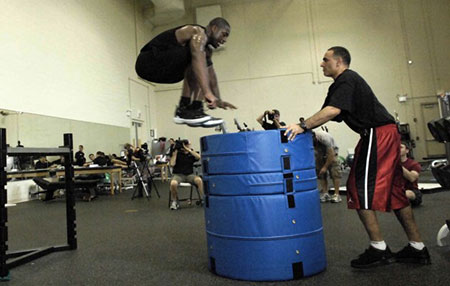
These are key aspects to consider when discussing plyometrics since they determine how successful your jump training will be, especially when your vertical jump starts peaking and you’re looking for new ways to raise it.
This is a classic example of how the key to boosting your vertical may be hidden in the smaller things, such as your arm movement that’s lacking, which if fixed would allow you to transmit more power into your vertical jump.
Summary
When the ultimate goal is to jump higher, plyometrics are one of the best ways to do so.
They’re extremely effective at raising your jump and should be incorporated into every vertical leap training routine you follow.
One example of a program that combines plyometrics in a highly advanced way is Jacob Hiller’s program – The Jump Manual.
The program accomplishes this by providing workout routines that are specifically designed for vertical jumpers and high jumping.
Coach Hiller explains the significance of plyometrics for vertical leap athletes in his own words:
More Info
1) Plyometrics – definition, history and development – Official Wikipedia – https://en.wikipedia.org/wiki/Plyometrics
2) WebMD – excellent article by Kara Mayer Robinson on plyometrics, what it is and how to do it – http://www.webmd.com/fitness-exercise/a-z/what-is-plyometrics
Last Updated on by Matthew Godley
More from my site
 Vert Shock Program Review – WARNING! Beware The Results!
- 3 Aspects Needed For Effective Vertical Leap Training
- The Jump Manual Review: Does The Program Really Work? Here’s My Results!
- Effective Shooting Techniques for Becoming a Clutch Scorer
- Air Alert Program Review: Thinking About Doing Air Alert? STOP!